Mental Health Figures in Rare Skin Diseases
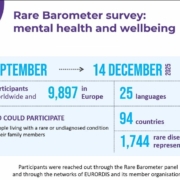
In June 2026, RareBarometer, Eurordis’ polling organisation, published the results of the survey conducted in 17 European countries from 11th September to 14th December 2025. 130 people representing 13 rare skin diseases responded.
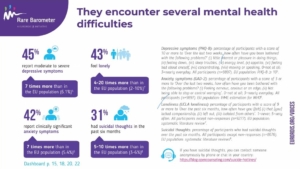
The figures speak for themselves:

  • 7 out of 10 people living with a rare skin disease and their families report poor mental health.
  • 50% report moderate to severe depressive symptoms (8 times more than the European population (6.1%))
  • 44% report significant clinical symptoms of anxiety (8 times more than the European population (5.4%))
  • 39% feel lonely (4 to 20 times more than the European population (2 to 10%))
  • 37% report suicidal thoughts in the last 6 months (6 to 12 times more than the European population (3 to 6%))
  • 48% report at least 2 severe mental health difficulties
  • 28% report at least 3 severe mental health difficulties
  • 14% report at least 4 severe mental health difficulties
  • While 76% say they need professional psychological support, only 46% receive it
      • 25% of a general practitioner or nurse taken care of
      • 21% of a professional not reimbursed, or paid by themselves (psychologist, psychotherapist, psychiatrist)
      • 17% of a professional fully or partially reimbursed (psychologist, psychotherapist, psychiatrist)
      • 11% of a Centre of Expertise (multidisciplinary care team specialising in rare or undiagnosed diseases)

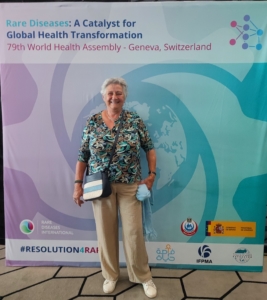
79th World Health Assembly (WHA)

20th May :

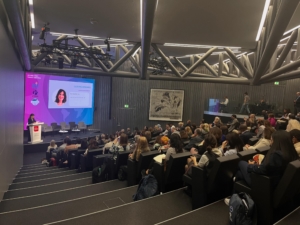
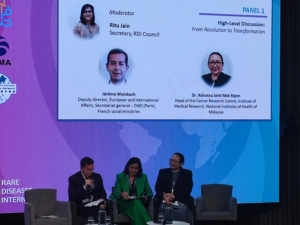
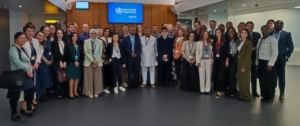
Rare Disease Internationale (RDI) had organised an event in Geneva ,

on the occasion of the 79th World Health Assembly (WHA).

Following the adoption, last year, of the resolution for Rare Disorders, it is now necessary to work on the Global Action Plan (GAP) that will implement the recommendations of the resolution.

21st May:

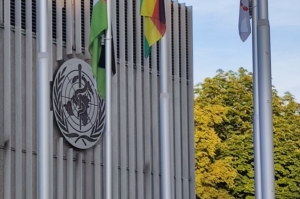
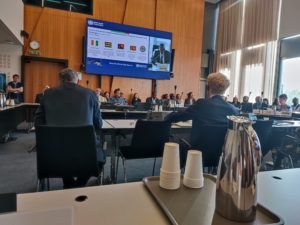
The next day, still in Genève, but this time in the World Health Organisation (WHO) building,

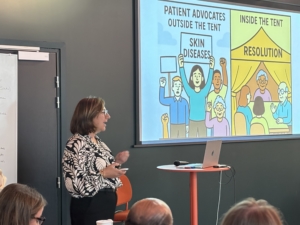
Globalskin had the opportunity to talk in the parallel session « From Resolution to Action : Implementing WHA Resolution on Skin diseases »  

organized by the WHO to hear patient organisations’ voices.

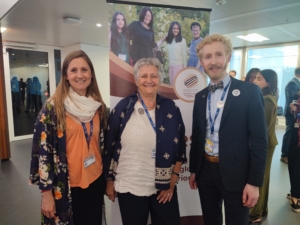
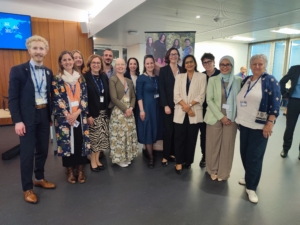
It was an honor to attend it together with ERN-Skin and Globalskin members.

Study about Teleexpertise in dermatology in a French region

TeleExpertise in dermatology

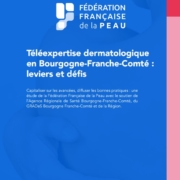
Marie-Claude Boiteux led a study  with the French Federation for Skin and ARS-BFC (Regional Agency of Health in Bourgogne-Franche-Comté) and supported by A-Fluence Consulting. Compensating for desertification in dermatology, allowing patients to have rapid access to a consultation when necessary, promoting the development of the skills of general practitioners, while participating in the care pathway, while this new tool is certainly not the universal panacea, it prevents symptoms from worsening and patients from missing opportunities.

Read the study (in French)

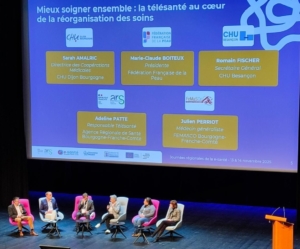
On 14th November 2025, the Regional Agency of Health (ARS-BFC) held the first conference dedicated to new ways to practice medicine thanks to new technologies at the Convention Centre of Dijon, Bourgogne-Franche-Comté. During these Regional e-Health Days , Marie-Claude presented the first results of this study in the roundtable dedicated to « Tele-Expertise ».

see the replay (in French)

MAPPING RARE

28th February 

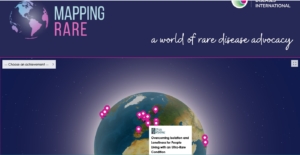
On the occasion of Rare Disease Day 2026, Rare Disease International opened the

« Mapping Rare » page on its website

(www.rarediseaseinternational.org/mapping rare/)

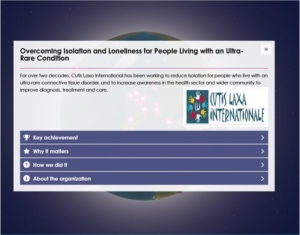
Cutis Laxa International  is in the spotlight.

When you click on the spot, you access to lots of information

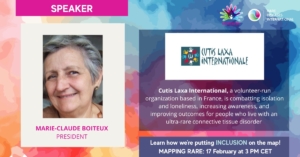
Ahead of the official opening, Marie-Claude Boiteux, presented it during a webinar


Dermatology Days of Paris

2nd December

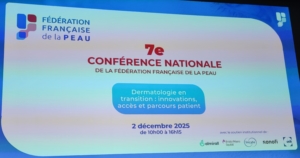
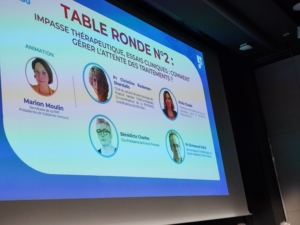
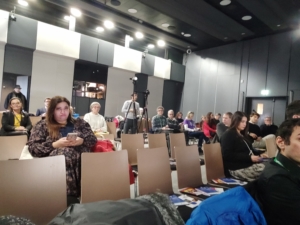
The 7th Conference of the French Federation for Skin (FFP) was held, as usual, in Paris Convention Center, as a preamble of the Dermatology Days of Paris (JDP). Therapeutic revolutions, Clinical Trials, Alternatives to Desertification and Integrative Health: 4 themes developed in the round table discussions. They captivated the audience and highlighted the work carried out by the FFP to improve patients’ quality of life.

3rd-6th December

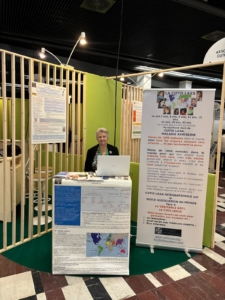
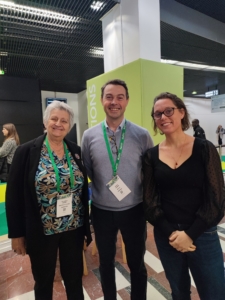
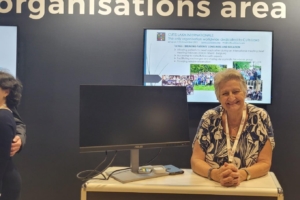
Having a stand in the village of associations during the Dermatological Days of Paris (JDP) is an opportunity, every year, to increase Cutis Laxa’s visibility. It is also an opportunity to meet doctors, researchers and laboratories interested in our pathology and the projects we are carrying out. AND it’s always nice to meet up with our colleagues and friends from the associative world. This year, our visibility increased even more with our poster alongside those of doctors and researchers.

Have a look at the JDP2025 retrospective were Marie-Claude Boiteux talks about the Associations’ village (at 1:04)

The role of ERNs in boosting EU competitiveness through public-private partnerships

Together for Rare Diseases (Together4RD) has published a report on the use of public-private partnerships (PPPs) in rare disease research, and the role ERNs have to play in this context in order to boost European competitiveness and drive change for the rare disease community. The report was developed following a high-level conference hosted by MEPs Stine Bosse (Renew Europe, Denmark) and András Kulja (EPP, Hungary), in collaboration with Together4RD, at the European Parliament on 24 September.

Drawing on the discussions held during the conference, the report puts forward a number of action items to facilitate ERN-industry collaboration, thereby accelerating innovation and improving the availability of treatments and care for patients. Some of the actions outlined in the report are:

  • Ensure the Biotech Act, Life Sciences Strategy and Multiannual Financial Framework promote collaborative research and provide resources for ERNs and industry to enter research partnerships.
  • Revise the 2019 ERN Board of Member States (BoMS) statement to explicitly allow and encourage ERN-industry research and data collaboration.
  • Develop and deploy a standardised EU-wide contracting and data-sharing framework for ERN-industry partnerships.
  • Support ERNs in becoming legal entities or forming shared-governance structures to streamline partnerships.
  • Establish an EU Rare Disease Action Plan with measurable targets and stable funding.

By combining the expertise of ERNs, the capabilities and resources of industry, and the input of patient communities, this type of PPP has the potential to deliver concrete change and improved health outcomes for all Europeans living with a rare disease. (© Orphanews 2025.11.25)

Three new national plans for rare diseases in the world :

They all are in line with the recent adoption of the World Health Assembly (WHA)’s Resolution on Rare Diseases, which recognises the global challenges faced by PLWRD. (© Orphanews 2025.10.06)

Malaysia

This is the nation’s first ever strategy for rare diseases. It aims to address critical gaps and strengthen the delivery of comprehensive healthcare solutions for PLWRD in Malaysia. The policy defines a disease as rare if it affects fewer than 1 in 4,000 people, and identifies 9 key pillars of action to improve rare disease care, diagnosis and awareness

Ireland

The Irish Department of Health unveiled their National Rare Disease Strategy 2025-2030. This strategy builds on the foundation of the previous National Rare Diseases Plan for Ireland 2014-2018, and addresses issues encountered by PLWRD throughout all stages of life. The result of multi-stakeholder collaboration between patients, clinicians, researchers, and government representatives, the strategy puts forward 11 recommendations to reinforce rare disease care and awareness in Ireland.

Luxembourg

The Ministry of Health adopted the country’s second national plan for rare diseases, the “Plan National Maladies Rares Luxembourg” 2025-2029 (PNMRL). This plan represents a continuation of the first national plan, which was in place from 2018 to 2023. It aims to promote a reinforced, coordinated healthcare system for PLWRD in Luxembourg. It takes a holistic, person-centred approach to the challenges facing the rare disease community across five thematic areas.

FIMARAD Annual Meeting

3rd October :

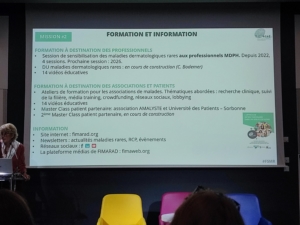
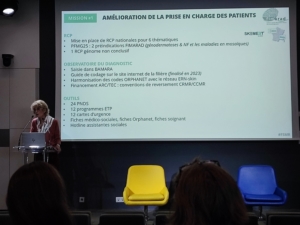
The annual meeting of FIMARAD (French Network for Rare Skin Disorders) took stock about projects and advances in the network regarding diagnosis, therapeutics and follow-up.  The forthcoming publication of an article written together by patients and health professionals on the diagnostic odyssey is of special interest to health authorities.

We were also celebrating the network’s 10th anniversary,  an important step marked by Pr Christine Bodemer stepping back and  handing over the coordination to Pr Smaïl Hadj-Rabia.

Globalskin Europe and EADV in Paris

16th September : GLOBALSKIN

Globalskin Europe members met in Paris about Advocacy Strategies, working on opportunities and challenges when interacting with national and/or European policy makers.

A great opportunity to meet with colleague Patient Organisation Leaders

17th-20th September : EADV

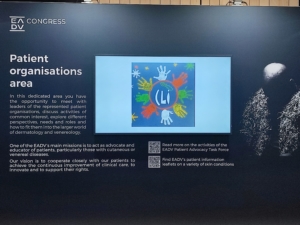
The European Academy of Dermatology-Venerology (EADV) held its annual conference in Paris.

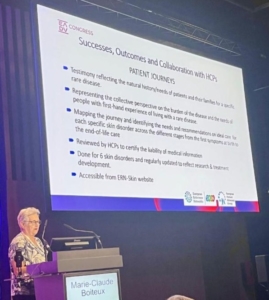
Besides the possibility to have a booth increase the visibility of Cutis Laxa, Marie-Claude Boiteux spoke about the successes and projects led by the Patient Representatives (ePAGS) during the session dedicated to the work done in ERN-Skin.

Disabilities and Barriers in rare skin disorder

Recognising Disabilities and Barriers in rare skin disorder : key-findings of the Rare barometer  survey

  •  7 / 10 people with rare skin disorders live with disabilities;
  • 66% of respondents have difficulties with at least two of the following activities: seeing, hearing, walking/climbing stairs, remembering/concentrating, selfcare, communicating;
  • 59% find it difficult or very difficult to obtain publicly funded support such as attendant care support, home support, financial support, assistive technology, mobility aids or other support;
  • 52% experienced discrimination related to the rare disease or disability in healthcare, in employment, in education, in housing, in public accommodations and in other places;
  • 14% of people with a rare skin disorder are unemployed (in comparison, the unemployment rate in the general population was 6,1% in the European Union in 2023)