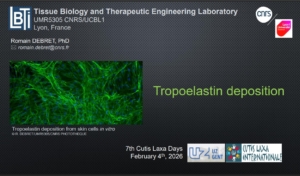
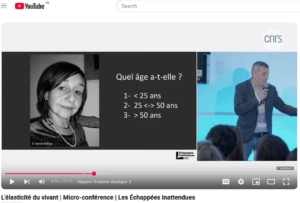
Tropoelastin deposition to treat elastic fiber diseases ?

Dr Romain DEBRET

See the presentation

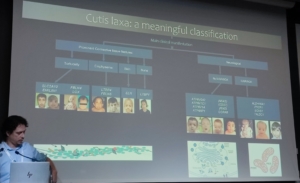
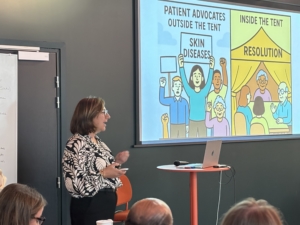
25 years ago, when we founded Cutis Laxa Internationale, access to a therapy seemed to be an unaccessible dream. Today thanks to researchers such as Romain Debret this hope is getting closer and therapeutic avenues are emerging.

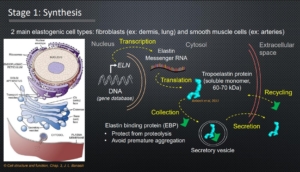
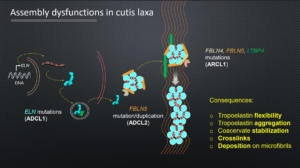
After recalling the elements that make up the structure of Elastic Fibers, and the place that troposelastin holds in them, he shared the fruit of his labors: Creating a synthetic tropoelastin that could replace the faulty one in Cutis Laxa. In vitro results are encouraging.

Yet we are still far from a possible therapy for humans, but hope starts to take shape.

CUTIS LAXA PATIENT JOURNEYS

NEW PATIENT JOURNEYS

We have developed 2 patient journeys based on testimonies from our members on what it is like to live with a Cutis Laxa.

Those documents aim to be a tool for health care professionals and patients during a consultation to help them agree on the best possible care on a long term basis.

The Patient Journeys have been updated recently to better fit with today’s knowledge on Cutis Laxa.

CUTIS LAXA WITH ARTERIES AND LUNGS SYMPTOMS

CUTIS LAXA WITH NEURO AND SKELETON SYMPTOMS


ERN-Skin Board Meeting

11th-12th December 

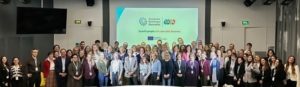
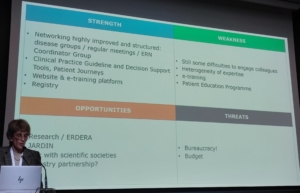
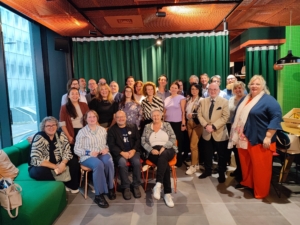
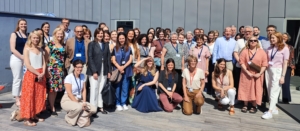
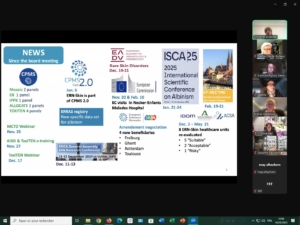
Members of ERN-Skin got together for the annual Board Meeting that takes stock of what was done over the year and future projects.

Cutis Laxa was honored thanks to the method of classification established with AI that allows a reduction the diagnosis odyssey. This new classification is more detailed in the page dedicated to the 7th Cutis Laxa Days.

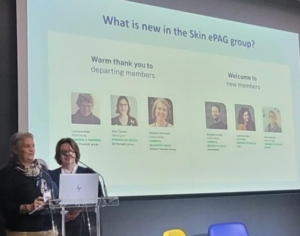
The group of patient representatives (ePAGS) was extended with new members in attendance.


Dermatology Days of Paris

2nd December

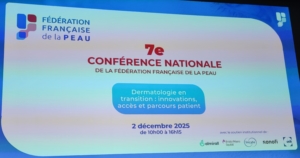
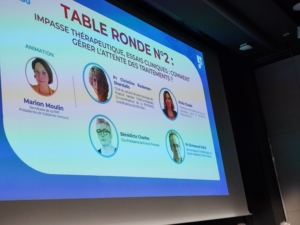
The 7th Conference of the French Federation for Skin (FFP) was held, as usual, in Paris Convention Center, as a preamble of the Dermatology Days of Paris (JDP). Therapeutic revolutions, Clinical Trials, Alternatives to Desertification and Integrative Health: 4 themes developed in the round table discussions. They captivated the audience and highlighted the work carried out by the FFP to improve patients’ quality of life.

3rd-6th December

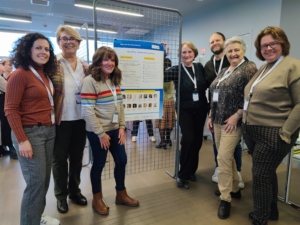
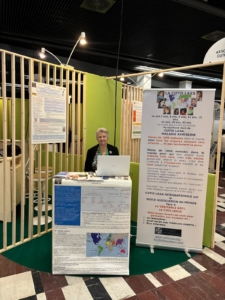
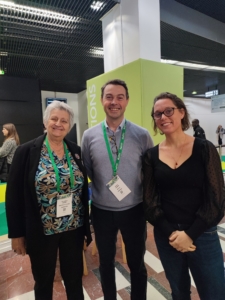
Having a stand in the village of associations during the Dermatological Days of Paris (JDP) is an opportunity, every year, to increase Cutis Laxa’s visibility. It is also an opportunity to meet doctors, researchers and laboratories interested in our pathology and the projects we are carrying out. AND it’s always nice to meet up with our colleagues and friends from the associative world. This year, our visibility increased even more with our poster alongside those of doctors and researchers.

Have a look at the JDP2025 retrospective were Marie-Claude Boiteux talks about the Associations’ village (at 1:04)

The role of ERNs in boosting EU competitiveness through public-private partnerships

Together for Rare Diseases (Together4RD) has published a report on the use of public-private partnerships (PPPs) in rare disease research, and the role ERNs have to play in this context in order to boost European competitiveness and drive change for the rare disease community. The report was developed following a high-level conference hosted by MEPs Stine Bosse (Renew Europe, Denmark) and András Kulja (EPP, Hungary), in collaboration with Together4RD, at the European Parliament on 24 September.

Drawing on the discussions held during the conference, the report puts forward a number of action items to facilitate ERN-industry collaboration, thereby accelerating innovation and improving the availability of treatments and care for patients. Some of the actions outlined in the report are:

  • Ensure the Biotech Act, Life Sciences Strategy and Multiannual Financial Framework promote collaborative research and provide resources for ERNs and industry to enter research partnerships.
  • Revise the 2019 ERN Board of Member States (BoMS) statement to explicitly allow and encourage ERN-industry research and data collaboration.
  • Develop and deploy a standardised EU-wide contracting and data-sharing framework for ERN-industry partnerships.
  • Support ERNs in becoming legal entities or forming shared-governance structures to streamline partnerships.
  • Establish an EU Rare Disease Action Plan with measurable targets and stable funding.

By combining the expertise of ERNs, the capabilities and resources of industry, and the input of patient communities, this type of PPP has the potential to deliver concrete change and improved health outcomes for all Europeans living with a rare disease. (© Orphanews 2025.11.25)

Can cognitive behavioural group therapy help people living with a rare disease?

People living with a rare disease (PLWRD) often experience significant psychological burden, that results from a number of factors including physical pain, reduced income and increased medical expenses, and reduced social interactions. In addition, chronic physical conditions, as in most rare diseases, often occur alongside depression which can further exacerbate other mental health effects of the disease itself. In order to address this issue, a study was recently published in Intractable & Rare Diseases Research that investigates the effects of a mindfulness-based cognitive behavioural group therapy program for patients with a rare disease and deep depression.

The program described in the article consisted of three monthly sessions, each lasting 2 hours. Overseen by a clinical psychologist, it was designed to reduce psychological stress and improve quality of life in People Living With a Rare Disorder. (©Orphanews international 2025.10.06)

Globalskin Europe and EADV in Paris

16th September : GLOBALSKIN

Globalskin Europe members met in Paris about Advocacy Strategies, working on opportunities and challenges when interacting with national and/or European policy makers.

A great opportunity to meet with colleague Patient Organisation Leaders

17th-20th September : EADV

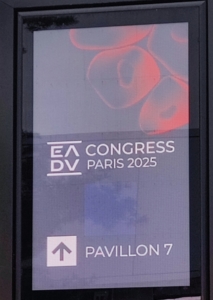
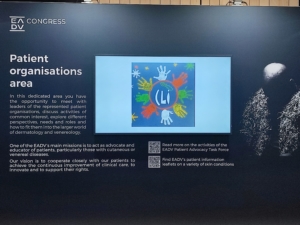
The European Academy of Dermatology-Venerology (EADV) held its annual conference in Paris.

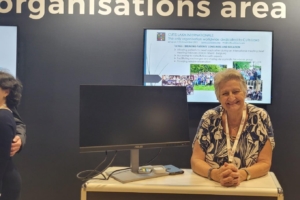
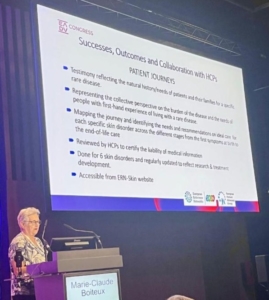
Besides the possibility to have a booth increase the visibility of Cutis Laxa, Marie-Claude Boiteux spoke about the successes and projects led by the Patient Representatives (ePAGS) during the session dedicated to the work done in ERN-Skin.

Pregnancy and Family Planning in Rare Disorders

Orphanet Journal of  Rare Diseases published the results of the survey for healthcare professionals « Pregnancy and Family Planning in Rare Diseases”

(read the publication)

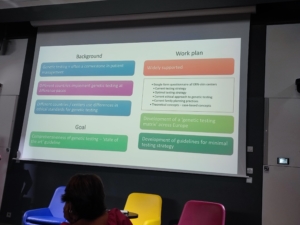
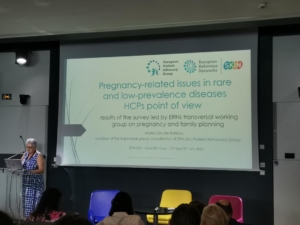
 Written by the European Reference Networks (ERNs) transversal working group that brings together patient representatives (EPAGs) (of which Marie-Claude Boiteux) and healthcare professionals (HCP) from 20 ERNs . After identifying 7 transversal domains to be explored in the survey (Fertility preservation, Pre-conceptional counseling, Family Planning counseling, Pre-implantation diagnosis, Prenatal diagnosis, Pregnancy monitoring, Post pregnancy monitoring/ lactation monitoring/counseling/newborn management), the group established closed and open-ended questions for each domain. These questions explored the level of importance, the activities performed by the center, the clinical challenges, the good practice and the educational activities related to the selected topics.

HCP, from 24 different countries answered the survey.

“Pre-conceptional counselling” and “pregnancy monitoring” were mentioned as important/very important at 83.3% and 75.6%, respectively. And « Family Planning Counselling » was considered very important/important at 71,6%.

The conclusions of this survey are pointing unmet needs for HCPs, including the need to improve communication between different HCPs, the lack of predefined organizational pathways, the lack of availability of expert HCPs for some pregnancy-related issues and the need to streamline the care provided among different European countries.

In addition, the survey underlined the need to improve the educational activities provided to ra

re disease patients.

Overall, the results pointed out the need to educate both physicians and patients on the basis of the emerging unmet needs. Online resources can be an excellent educational tool, they may help in disseminating and standardizing educational activities in order to homogenize the information for HCPs and patients.

Therefore, initiatives in this direction by scientific societies, ERNs and patient associations should be promoted and encouraged

A second questionnaire had been sent to patients. The answers are being analysed and should be soon published. It will then be possible to compare HCPs’ and patients’ views.


ERN-Skin Activities

16th January 2025 : Executive Committee (on line)

This annual meeting highlights the main aims, and projects for the coming years

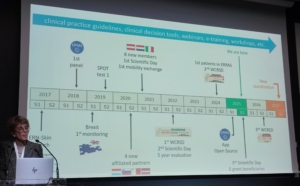
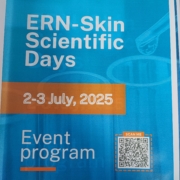
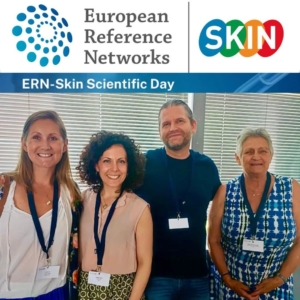
2nd-3rd July 2025 : Scientific Days

The latest research on each pathology, clinical cases and the work of young researchers were presented so we would be updated on the work and projects led in our European network.
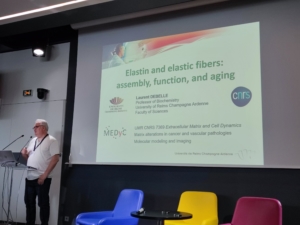
The work done by patient representatives was also honored with Marie-Claude Boiteux’s presentation of the publication « Pregnancy and Family Planning in Rare Disorders – A Heathcare Professionals survey » (see the post on this survey)