Mrs Aude Beyens, MD (Ghent, Belgium): Structural defects of Connective Tissue Proteins and CL

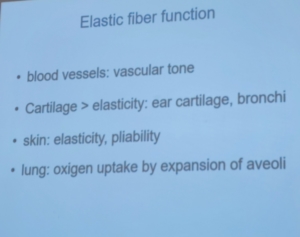
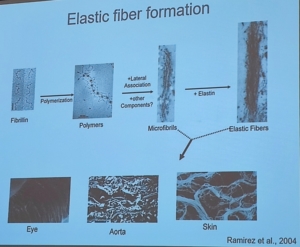
Elastic fiber assembly, or elastogenesis, is a complex process that is precisely regulated in a spatiotemporal manner and depends on proper growth factor signaling and mechanosensing.


The underlying molecular defect in cutis laxa syndromes affect the synthesis and/or association associated extracellular matrix proteins.

Prof. Gerhard Sengle (Köln, Germany): Matrix Biology – What can we learn from animal modelling ?

Understanding how the fine tune mechanisms of elastic fibers formation is perturbed in the different types of Cutis Laxa is crucial to design molecular therapies in preclinical trials using animal models.

NEW MUTATIONS

4 new genetic mutations were recently found:


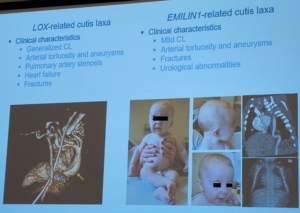
LOX : This gene of the 5-Lysyl oxidase family is involved in initiating of cross-linking of Elastin and Collagen. The mutation leads to cardiovascular, respiratory and bone symptoms, especially fractures. This is why it was initially considered to be a new type of osteogenesis imperfecta (glass bones disorder). But the discovery of fragmented elastic fibers allowed this mutation to be included in Cutis Laxa Syndroms. It is a recessive form.


EFEMP1 (Fibulin3): The consequences, besides lax skin, of this mutation are multiple hernias and joint hypermobility as well as mild intellectual/learning disability. It is a new recessive type of Cutis Laxa.


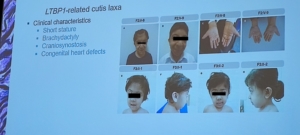
LTBP1 : This mutation is distinguished by lax skin, inguinal hernias, craniofacial dysmorphology, various heart defects and prominent skeletal features (short stature, brachydactyly, craniosynostosis,..). It is another new recessive type of Cutis Laxa.


PI4K2A : This 4th new mutation is characterised by the following clinical signs : lax skin, involuntary movements (neurological issue), dysmorphism and intellectual/learning disability. It is also a recessive type.


A 5th new mutation has recently been found and we are longing for it to be published so we can tell you about it.


Thanks to all the researchers for their amazing work in basic knowledge of Cutis Laxa. All these findings are essential to give patients better care and offer them a better quality of life.


 

NEW MUTATIONS

Even if I cannot tell you more since publications have not yet taken place, I am very happy and proud of our researchers who work on Cutis Laxa :

5 NEW MUTATIONS have just been discovered.

For all patients whose precise type has not yet been identified, this is an extraordinary chance.

You can be tested now with the new mutations.

Attending the 6th Cutis Laxa Days in Ghent in September 2022  can be the opportunity for you to know more about the precise type you are suffering from.

Living with …. Cutis Laxa

The French monthly magazine “La Revue du Praticien” (The Medical Practitioner’s Journal) published an article on Cutis Laxa in its November issue.


Read the article here (in French)

A New Type of Cutis Laxa

In March, the American Journal of Medecine Genetics published an article showing that a mutation on the gene PTDSS1 leads to a very rare type of Cutis Laxa :  Lenz-Majewski Syndrome (LMS) . It includes Cutis Laxa with growth delay, dwarfism and intellectual delay. According to this study of 3 cases, this is a new type of Cutis Laxa that needs to be added to those already identified.

12 different mutations have been identified

As of today, 12 different mutations have been identified leading to Cutis Laxa. That is why Cutis Laxa classification will soon be reviewed.

  • Elastine (ELN) (2 mutations) – ADCL
  • Fibuline5 (FBLN5) – ARCL1A
  • Fibuline4 (FBLN4) – ARCL1B
  • LTBP4 – ARCL1C
  • ATP6V0A2 – ARCL2A
  • PYCR1 – ARCL2B
  • ATP6V1E1 / ATP6V1A – ARCL2C
  • ALDH18A1 – ARCL3 (De Barsy Syndrom)
  • SCYL1BP1 (Géroderma Osteodysplastica)
  • ATP7A (Occipital Horn Syndrom)
  • RIN2 (MACS Syndrom)

BewarenBewaren